The Mekong Delta rewards a night's stay far more than a day trip. A day out to Ben Tre or My Tho is easy and pleasant: a sampan through water coconut canals, a coconut candy workshop, a cycle past orchards. But the delta's best hour is dawn on the river, and you only get that by sleeping in Can Tho. With three nights, go further to Chau Doc, near the Cambodian border, for flooded forest, a sacred mountain and Cham villages.
How we built this guide: on 2 October 2026 we checked bus listings on Vexere and Baolau, The Sinh Tourist's published tour prices, Can Tho's official tourism site, several Vietnam National Authority of Tourism pages, a 2025 Al Jazeera report on floating markets, a 2025 flood report, the UK government's travel advice, WMO climate normals and traveler-reported cost data. We did not visit for this update.
How does the Mekong Delta work for visitors?
Think of the delta in three bands by distance from Ho Chi Minh City. Ben Tre and My Tho, 70 to 95 km away, are day-trip country. Can Tho, about 170 km away, is the delta's main city and the base for Cai Rang floating market. Chau Doc, about 195 km by road, is a river town on the Cambodian border, with Cham communities and a busy pilgrimage mountain.
Province names changed in 2025, which affects addresses and maps. Ben Tre merged into Vinh Long province, Tien Giang (My Tho's province) into Dong Thap, Kien Giang into An Giang (Chau Doc's province), and Soc Trang and Hau Giang into Can Tho city (vietnam.travel). Town names such as Ben Tre, My Tho and Chau Doc are still what you will see on buses and tours.
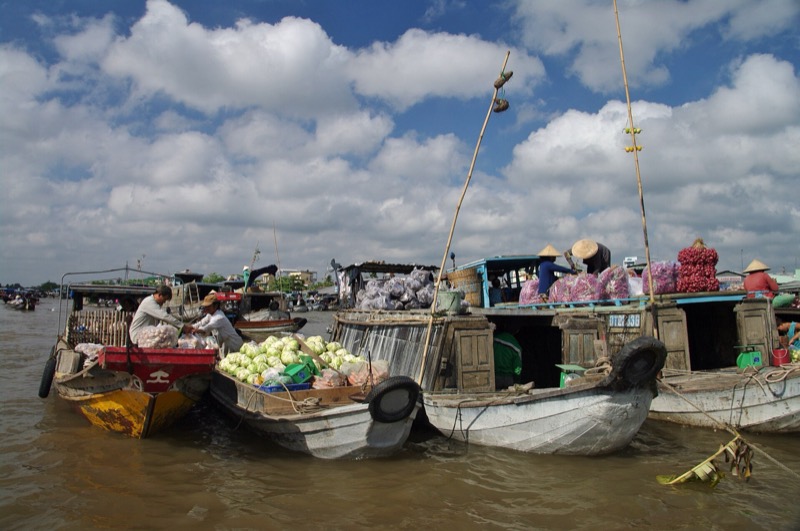
The floating markets are shrinking. Al Jazeera reported in February 2025 that only two of the delta's ten major markets keep any significant presence, that Cai Rang has about 200 vessels, fewer than half as many as at its 1990s peak, and that the Cai Be market closed for good in 2021. Cai Rang is still worth an early start, but go for the river life rather than a postcard of hundreds of boats.
Day trip or overnight: which suits you?
One night in Can Tho is the best value for most travelers. The table sets out the options.
| Plan | Where | What you get | Trade-offs |
|---|---|---|---|
| Day trip | Ben Tre or My Tho, about 1 hour 40 minutes to 2 hours 10 minutes each way by bus | Sampan ride through water coconut canals, coconut candy, cycling | No floating market at dawn |
| One night | Can Tho, about 2.5 to 4 hours each way | Cai Rang at 5 to 7 am, the Ninh Kieu riverfront | A very early start |
| Two nights | A homestay in Ben Tre or Vinh Long, then Can Tho | Orchards, canals and evening village life | More transfers |
| Three nights or more | Add Chau Doc | Tra Su forest, Sam Mountain, Cham villages | About 6 hours from Ho Chi Minh City by bus |
If you only have one day, choose Ben Tre or My Tho over a dash to Can Tho: by the time a same-day trip reaches Cai Rang, the morning trading has passed. Our Ho Chi Minh City to Can Tho guide explains the timing.
Ben Tre and My Tho, Can Tho or Chau Doc: where should you go?
Go to Ben Tre or My Tho for an easy day, Can Tho for the river at work, and Chau Doc for the most varied stay.
Ben Tre and My Tho
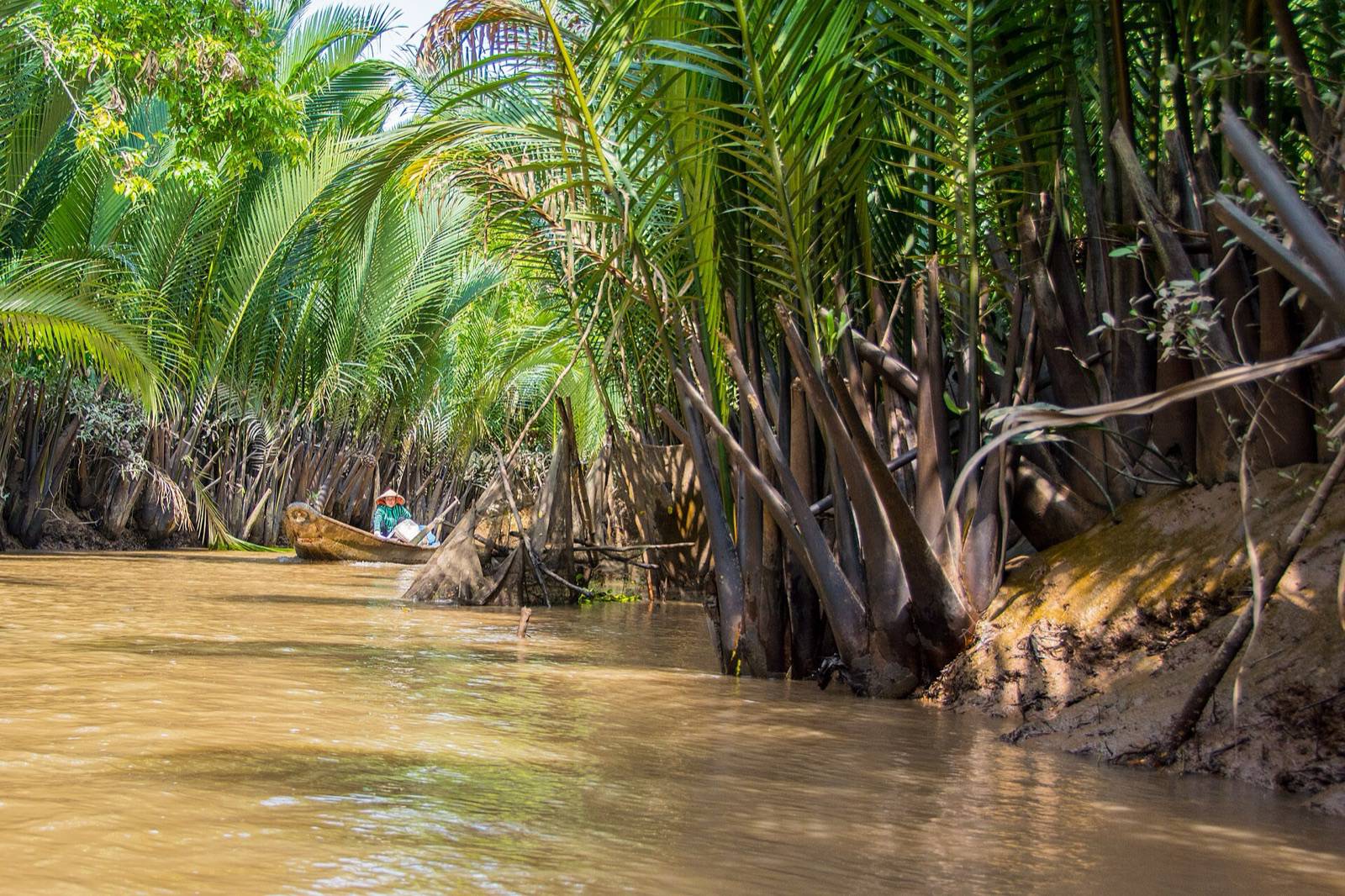
These are the closest and greenest slices of the delta. Baolau puts My Tho 70 km and about 1 hour 40 minutes from Ho Chi Minh City by bus, and Vexere puts Ben Tre at 95 km and about 2.1 hours, with 104 departures a day. Vietnam's tourism board describes Ben Tre as about a two-hour drive and known for its coconuts, with boat rides along the river and stops at coconut candy factories where the sweets are made and packed by hand (vietnam.travel). It counts more than 300 coconut candy factories in the area (vietnam.travel), and notes that a sampan ride through the palm fronds is almost always included on day trips (vietnam.travel).
The Sinh Tourist's My Tho and Ben Tre day tour costs 499,000 VND, leaving at 8:30, or 699,000 VND for a deluxe version (The Sinh Tourist). Going on your own is also simple, since buses are frequent.
Can Tho and Cai Rang floating market
Can Tho is the place to sleep if you want to see the river at work. Can Tho's official tourism site puts the best time at Cai Rang at 5 to 7 am, about 30 minutes by boat from Ninh Kieu wharf. MoMo's travel guide lists shared boats at about 100,000 VND per person and private boats at 300,000 to 500,000 VND (MoMo). Book the evening before and leave around dawn.
Getting there takes about 2.5 to 3.5 hours by car or limousine van and about 4 hours by big bus, since the expressway now runs the whole way. Our Ho Chi Minh City to Can Tho guide compares operators and fares.
Chau Doc and Tra Su forest
Chau Doc is the delta at its most varied, and worth the longer ride. Baolau gives the distance from Ho Chi Minh City as 195 km and about 6 hours on FUTA's sleeper buses from Mien Tay bus station, with a 240,000 VND fare for 8 October 2026.
Vietnam's tourism board (vietnam.travel) describes a sprawling market known for mam, fermented fish, and Cham communities on the Chau Phong and Chau Giang islets, with stilt houses, mosques and weaving workshops. On Sam Mountain, the Cave Pagoda looks out toward Cambodia, and Mieu Ba Chua Xu at its foot is one of the busiest religious sites in Vietnam.
Tra Su, 23 km outside town, covers 850 hectares of cajuput forest that you cruise by small motorboat over a carpet of duckweed. Mekong Smile's guide, updated on 2 October 2026, lists entry at 120,000 VND, a motorboat at 80,000 VND and a rowing boat at 70,000 VND, with the site open from 6:30 to 18:00 and a visit taking two to three hours (Mekong Smile).
Should you stay in a homestay?
Yes, for one night, if you want delta life beyond a tour stop. Vietnam's tourism board describes homestays where you might explore the village by boat, go fishing with your hosts or help in the rice fields, often with the chance to join in the cooking (vietnam.travel).
An Binh islet in Vinh Long, more than 60 square kilometers between the Co Chien and Tien rivers, has had homestays since 2000, with orchards where guests taste the fruit, plus fishing and cake-making, VTV reported in 2019. Rooms are simple, so ask what is included, such as dinner and transfers, before you compare prices.
Where should you stay in the Mekong Delta?
Base yourself in Can Tho for one night, and add Chau Doc or a homestay if you have more time.
| Base | Best for | Trade-offs |
|---|---|---|
| Can Tho, near Ninh Kieu wharf | Dawn boats to Cai Rang, riverfront restaurants, the widest choice of hotels | A busy city rather than a village |
| Ben Tre | Cycling coconut country after the day-trippers leave | Fewer big sights |
| An Binh islet, Vinh Long | Orchard homestays and quiet canals | Basic rooms; you depend on your hosts for transport |
| Chau Doc riverfront or Sam Mountain | The market, Cham villages, Tra Su and sunrise views from the mountain | Furthest from Ho Chi Minh City |
Budget Your Trip puts average hotel rooms in Can Tho at about $16 (420,000 VND) in the low season and $30 (780,000 VND) in the peak season, based on Kayak data, with budget rooms from about $10.
How do you get to the Mekong Delta?
By road from Ho Chi Minh City. Most big buses to the delta leave from Mien Tay bus station, and limousine vans from company offices. Our Ho Chi Minh City guide helps you choose a base in the city before you go, and Starting from Ho Chi Minh City lists the other routes out.
| Destination | Distance | Time by bus | Fare seen | Source |
|---|---|---|---|---|
| My Tho | 70 km | About 1 hour 40 minutes | Not listed for our date | Baolau |
| Ben Tre | 95 km | About 2.1 hours | Average 162,500 VND | Vexere, 2 Oct 2026 |
| Can Tho | About 170 km | About 4 hours by big bus, 2 hours 40 minutes by limousine van | FUTA 195,000 VND | Vexere, 2 Oct 2026, and our route guide |
| Chau Doc | 195 km | About 6 hours | 240,000 VND on FUTA | Baolau, for 8 Oct 2026 |
How do you get around the delta?
By boat for the canals and markets, and by bicycle in the orchard country. Vietnam's tourism board says most hotels in Ben Tre offer free bicycles for guests (vietnam.travel). Between towns, use buses, limousine vans or a car with a driver; our getting around Vietnam page covers ride-hailing and car hire.
What safety issues are specific to the delta?
Water, heat and night roads are the delta-specific risks. Our Vietnam safety page covers the rest.
- Seasonal floods. The UK government lists seasonal flooding in the Mekong Delta and says it can disrupt overland travel. In 2025 the river at Chau Doc was forecast to reach 3 m by the end of August, higher than normal, Vietnam News reported. High water is what makes Tra Su beautiful, but check road conditions before long rides.
- Night buses. The UK government says bus and coach crashes are more likely at night, when drivers may be tired. On routes this short, travel by day.
- Small boats. Wear the life jacket you are given, keep your phone in a dry bag, and step into the middle of the boat when you board.
- Heat and mosquitoes. Average highs in Ho Chi Minh City stay between 31.6 and 34.9 degrees Celsius all year (WMO). Carry water and repellent, and see vaccinations and health for dengue advice.
How much does the Mekong Delta cost?
The delta is cheap, and transport and boat trips are the main costs. We converted at about 26,000 VND to US$1, between Vietcombank's published USD buying and selling rates (25,760 and 26,170) on 2 October 2026.
| Item | Price in VND | About in USD | Where we saw it |
|---|---|---|---|
| Day tour, My Tho and Ben Tre | 499,000 | $19 | The Sinh Tourist, Oct 2026 |
| 2-day tour, Ben Tre, Can Tho, Cai Rang and Vinh Long | 2,190,000 | $84 | The Sinh Tourist, Oct 2026 |
| 3-day tour including Tra Su | 3,490,000 | $134 | The Sinh Tourist, Oct 2026 |
| Bus to Ben Tre, average fare | 162,500 | $6.25 | Vexere, 2 Oct 2026 |
| FUTA bus to Can Tho | 195,000 | $7.50 | Vexere, 2 Oct 2026 |
| FUTA bus to Chau Doc | 240,000 | $9.20 | Baolau, for 8 Oct 2026 |
| Cai Rang boat, shared | about 100,000 per person | $3.85 | MoMo, undated |
| Cai Rang boat, private | 300,000 to 500,000 | $11.50 to $19 | MoMo, undated |
| Tra Su entry | 120,000 | $4.60 | Mekong Smile, 2026 |
| Tra Su motorboat and rowing boat | 150,000 for both | $5.80 | Mekong Smile, 2026 |
| Hotel room in Can Tho, average | about 420,000 to 780,000 | $16 to $30 | Budget Your Trip, Aug 2026 |
| Budget day in Can Tho, per person | about 725,000 | $28 | Budget Your Trip, traveler-reported |
What food is worth seeking out in the Mekong Delta?
Freshwater fish, coconut and noodles. Vietnam's tourism board's delta food guide picks elephant ear fish, fried whole and served standing upright, then rolled in rice paper with pickles, cucumber and herbs. It also recommends banh xeo, a large pancake filled with pork, bean sprouts and shrimp, especially in Can Tho and Soc Trang, and banh cong, a savory fritter of mung beans, taro and rice flour. Ben Tre is the place for coconut candy.
In Chau Doc, start the day with bun ca, a turmeric-tinted fish noodle soup with crunchy dien dien flowers, and look for banh bo Cham, a cake of palm sugar and coconut milk cooked under hot clay lids (vietnam.travel).
When is the best time to visit the Mekong Delta?
December to April is the dry season and the easiest time to travel, while September to November brings high water that suits Tra Su but can disrupt roads. Can Tho has no WMO-listed station, so the table uses normals for Ho Chi Minh City, about 170 km away, and Ca Mau, in the far south of the delta.
| Months | Rain in Ho Chi Minh City | Rain in Ca Mau | In the delta |
|---|---|---|---|
| December to April | 8 to 57 mm a month | 18 to 89 mm a month | Dry, hot and sunny; the busy season |
| May to August | 202 to 231 mm a month | 224 to 340 mm a month | The rainy season sets in |
| September to November | 128 to 273 mm a month | 202 to 369 mm a month | High water upstream; Tra Su at its fullest |
Budget Your Trip notes that Can Tho's winter peak season brings higher prices and crowds, and Mekong Smile names September to November as Tra Su's high-water period. For the whole country, see best time to visit Vietnam.
Key facts at a glance
- Cai Rang timing: best between 5 and 7 am, about 30 minutes by boat from Ninh Kieu wharf (Can Tho tourism).
- Floating markets: only two of the delta's ten major markets keep a significant presence; Cai Rang has about 200 vessels (Al Jazeera, February 2025).
- Ben Tre: 95 km and about 2.1 hours by bus, 104 departures a day (Vexere).
- Chau Doc: 195 km and about 6 hours by bus (Baolau).
- New province names: Ben Tre is now in Vinh Long province and My Tho in Dong Thap (vietnam.travel).
Limitations
Fares and tour prices were checked on 2 October 2026 and change with demand. The Cai Rang boat prices come from an undated MoMo page, and Tra Su prices come from a tour company's 2026 guide; other guides list lower Tra Su fees, so confirm at the gate. The homestay details come from a 2019 report and a general tourism board article, not a survey of current homestays. Floating markets are changing fast, and our picture of them rests on a February 2025 report. Flood levels vary from year to year, so in the high-water months check road conditions and boat operations before long trips. We did not compare day-tour prices beyond The Sinh Tourist's list.