Hoi An is at its best when you sleep there. Day-trippers see a crowded Old Town at midday, while overnight guests get the quiet early mornings and the lantern-lit evenings. Plan two to three nights, budget 80,000 to 120,000 VND for the Old Town ticket, and avoid October and November if you want to be sure of dry streets.
How we built this guide: on 2 October 2026 we checked UNESCO's listing, the Government news portal's notice on the Old Town ticket, Da Nang's official tourism site, Vietnam's national tourism site, UK travel advice, 2025 and 2026 reporting on floods, beach erosion and the Japanese Covered Bridge restoration, and published cost data. We did not visit Hoi An for this update.
How does Hoi An work for a first-time visitor?
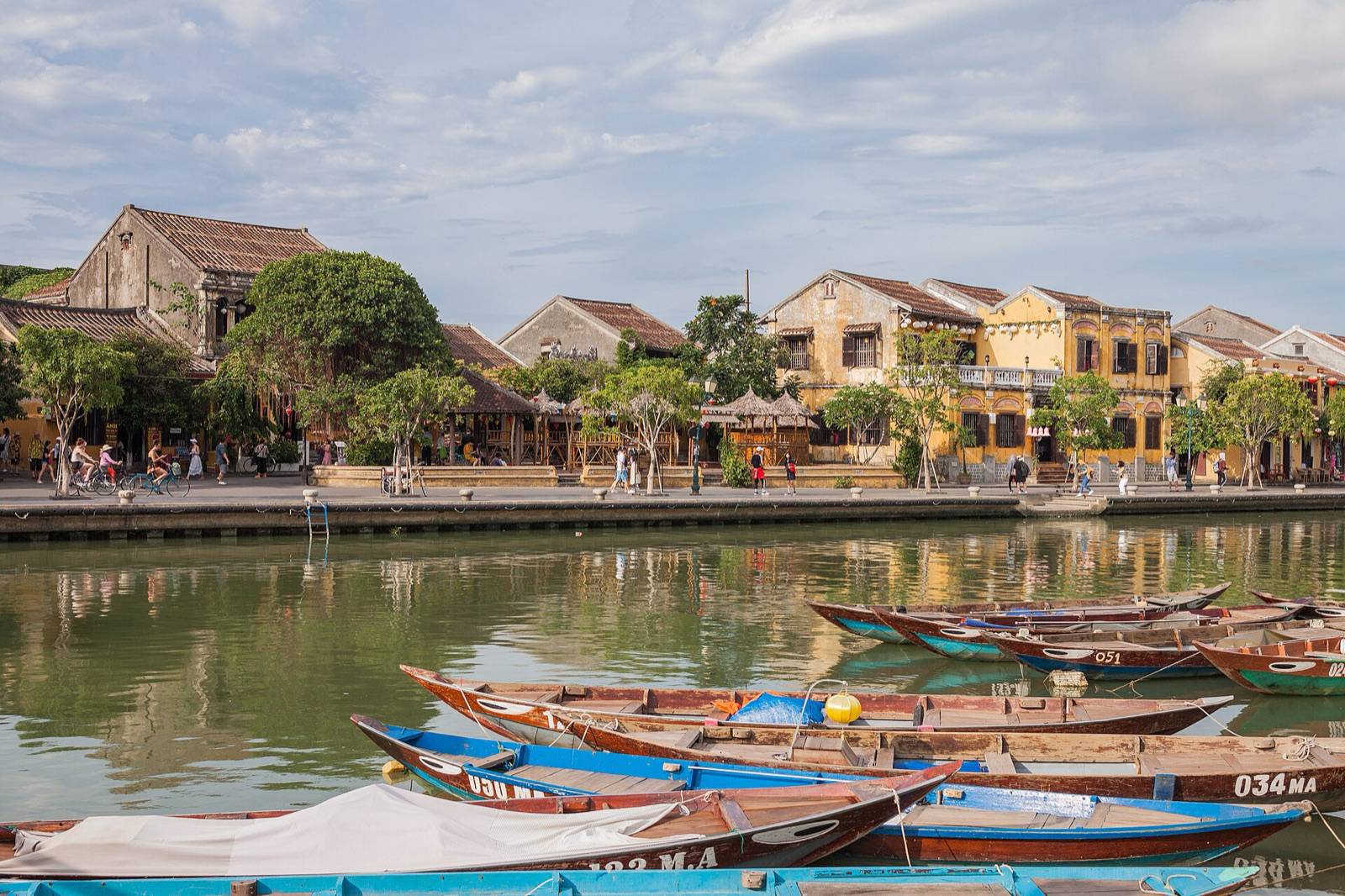
Hoi An is a small riverside trading town with a protected heritage core, and the rules of that core shape your visit. UNESCO, which listed the Ancient Town in 1999, describes a 30-hectare property of 1,107 timber-frame buildings from a port that traded with East and Southeast Asia and beyond from the 15th to the 19th centuries. Its grid of streets runs parallel to and back from the Thu Bon River, much as it did when goods came in by boat.
Around that core, the town spreads into rice fields, vegetable villages and, about 10 minutes away by road, the beach at An Bang. The Old Town itself has set hours for pedestrians: Da Nang's tourism office lists 9am to 9:30pm in summer and 9am to 9pm in winter.
The address on your booking may also look new. Since 1 July 2025, when Quang Nam province merged into Da Nang, Hoi An has been split into the wards of Hoi An, Hoi An Dong and Hoi An Tay plus the island commune of Tan Hiep, all part of Da Nang city. The Old Town sits in Hoi An ward, which holds 1,194 of the area's 1,439 listed relics, Bao Van Hoa reported.
How does the Old Town ticket work in 2026?
You need a ticket to enter the Old Town core, and the price is 80,000 or 120,000 VND. Official sources describe it in two slightly different ways, so it helps to know both.
| What the source says | Price | What it covers | Source |
|---|---|---|---|
| 2023 rule, international visitors | 120,000 VND (about US$4.60) | Entry to the Old Town core zone and its sites | Government news portal, April 2023 |
| 2023 rule, Vietnamese visitors | 80,000 VND (about US$3.10) | The same zone | Government news portal, April 2023 |
| 2026 package A | 80,000 VND | The shared Old Town space, the Japanese Covered Bridge or Quan Cong Temple, plus two more sites | Da Nang tourism office, March 2026 |
| 2026 package B | 120,000 VND | Adds the museum system, plus three more sites | Da Nang tourism office, March 2026 |
The rule that started on 15 May 2023 says every visitor must buy a ticket at a booth before entering, with checks from 7:30am to 9:30pm in summer and 7:30am to 9pm in winter, and separate lanes for residents (Dai Bieu Nhan Dan). The March 2026 description adds that one ticket can be used for up to three days, and that it includes traditional performances at 10:15, 15:15 and 16:15 and a Japanese tea ceremony at 9:30 and 16:30.
Two practical notes. Ask at the booth which package you are being sold, and keep the stub, since you may be asked for it when you re-enter. And around Tet the system can pause: in 2026, ticket sales and guided tours stopped from 16 to 19 February for New Year rituals (Bao Van Hoa).
How many days should you spend in Hoi An?
Two nights is the minimum that does Hoi An justice, and three is better. A simple plan:
- Day one: the Old Town early, before tour groups, then a rest and the town again after dark.
- Day two: a bike loop through the Cam Thanh and Tra Que vegetable farms, which the national tourism site recommends, then an afternoon at An Bang.
- Day three: the Cham temples of My Son Sanctuary, a UNESCO site about 40 km away, or a boat to the Cham Islands.
Add a night or two if you are having clothes made. Hoi An's tailors advertise 24 to 48 hour turnarounds, but a good fit usually needs more than one fitting.
Where should you stay: the Old Town, the beach or Da Nang?
Stay close to the Old Town for your first visit, and pick the beach or Da Nang only if the beach or the airport is your priority.
| Base | Best for | Trade-offs |
|---|---|---|
| Old Town and the riverside streets | Walking out at dawn and after dark, lantern nights, food | Crowded at peak hours, and the riverside streets are first to flood in October and November |
| Rice fields and villages (Cam Thanh, Tra Que) | Quiet nights, cycling, homestays | You need a bike or ride-hailing to reach town in the evening |
| An Bang beach | Mornings on the sand, seafood | Erosion has narrowed the beach, and town is a ride away |
| Da Nang | More hotels, a big city beach, the airport close by | Hoi An becomes a day trip of roughly 50 minutes each way |
Budget Your Trip's Kayak-based averages put a Hoi An hotel room at about US$28 (730,000 VND) in the low season and US$52 (1,350,000 VND) at peak, with a typical range from US$15 to US$121. Compare live prices for your dates.
What is worth your time in Hoi An?
The Old Town is the reason to come, but the best moments tend to be early, late or just outside the ticketed zone.
The Old Town at 7am
Walk the Old Town before the day crowds and the light is soft, the shops are opening and you can actually see the timber facades UNESCO protects. The Japanese Covered Bridge is back in use after a 19-month restoration, reopening on 3 August 2024 after work on its roof, wooden frame and foundations that cost over 20 billion VND (VTV).
Lantern nights
Once a month, around the full moon, public lighting in the Old Town is dimmed and the streets glow with lanterns, with candles floated on the river (Local Vietnam). It is beautiful and busy. Arrive before dark, eat early, and give yourself time to walk away from the riverfront crowds.
Tailors, done properly
Tailoring is a real Hoi An craft, not just a souvenir. Da Nang's tourism office describes a process of choosing fabric, discussing the design and several fittings, with turnarounds of 24 to 48 hours and shops lining Tran Hung Dao, Le Loi and Nguyen Thai Hoc streets. Order on your first day, bring a garment you like as a model, agree the price and the number of fittings in writing, and leave a spare day before you move on.
An Bang and Cua Dai beaches
An Bang is still the beach to choose, about 10 minutes from town. Both beaches have lost a lot of sand. After storms in early November 2025, DTiNews reported that nearly 3.5 km of coastline in Hoi An Dong and Hoi An Tay wards was eroded, that parts of the beach were cut back by 3 to 5 m into dangerous overhangs, and that only a narrow strip was left at Cua Dai.
How do you get to Hoi An?
Hoi An has no airport of its own, so most people arrive through Da Nang. The national tourism site puts Da Nang International Airport about a 50-minute drive from the Old Town.
- From Da Nang: car, ride-hailing, shuttle or bus. Our Da Nang to Hoi An guide compares them.
- From Hue: train to Da Nang plus a transfer, a bus, or a private car over the Hai Van Pass. See Hue to Hoi An.
- Heading south: sleeper buses and trains run on to Nha Trang. See Hoi An to Nha Trang, and the Starting from Hoi An and Da Nang hub for every route.
How do you get around Hoi An?
Walk inside the Old Town and cycle or ride everywhere else. Bicycles are the classic way to reach the Cam Thanh and Tra Que farm villages and An Bang. For evenings and rain, Grab lists Hoi An among its Vietnamese service areas. It is also worth checking the electric taxi firm Green SM (called Xanh SM until April 2026), which narrowly overtook Grab in Vietnam's ride-hailing taxi market in late 2024, with 37.41 percent against 36.62 percent, Viet Nam News reported.
What safety issues are specific to Hoi An?
Floods are the main risk, and they are a regular part of life here. The UK travel advice names October and November as the flood months in central Vietnam. A wooden column in the Quan Thang house on Tran Phu Street carries painted flood marks for 1964, 1999, 2007 and 2009, and Vietcetera reported that the late October 2025 flood peaked around 3.5 m, about 10 cm above the 1964 record. Days later, Tuoi Tre described the Hoai River rising again over Bach Dang, Le Loi and Nguyen Phuc Chu streets, with safety officers posted at flooded sections.
Watch out: in flood season, do not wade through moving water, keep passports and electronics above floor level, and follow the instructions of the safety officers posted at flooded streets.
At the beach, the eroded sand creates steep drops and overhangs, so keep children back from the edge and swim only where lifeguards are on duty. Elsewhere the usual Vietnam advice applies: hold bags away from passing motorbikes, and be careful with spirits, since UK advice warns of methanol poisoning from drinks sold in tourist areas.
How much does Hoi An cost?
Hoi An costs a little more than Hue and about the same as Da Nang, with the Old Town ticket as the one fixed fee. Prices were checked on 2 October 2026. We convert at 26,000 VND to US$1, rounded from Vietcombank's published rate that day (25,790 VND buying by transfer, 26,170 VND selling).
| Item | VND | About US$ | Source |
|---|---|---|---|
| Old Town ticket | 80,000 to 120,000 | 3.10 to 4.60 | Government portal and Da Nang tourism office |
| Hotel room, low to peak season average | 730,000 to 1,350,000 | 28 to 52 | Budget Your Trip (Kayak data) |
| Meal at an inexpensive restaurant | 60,000 | 2.30 | Numbeo |
| Meal for two, mid-range restaurant | 475,000 | 18 | Numbeo |
| Cappuccino | about 44,000 | 1.70 | Numbeo |
Numbeo's Hoi An page has only 13 contributors in the past 18 months and estimates some prices, so street food in particular can be cheaper than these figures.
What food is worth seeking out in Hoi An?
Eat the dishes you cannot get elsewhere in Vietnam first. VOV's list of what visitors rate in Hoi An is a fair starting point:
- Cao lau: chewy noodles with barbecued pork, bean sprouts and herbs. The name means "high floor".
- White rose dumplings (banh bao banh vac): translucent rice pouches of pork or shrimp, with fish sauce and crispy shallots.
- Mi Quang: turmeric noodles with pork, shrimp, quail egg, peanuts and rice cracker.
- Com ga: chicken rice, a dish VOV says Chinese traders brought to the town.
- Banh mi: Hoi An's sandwich shops are a reason on their own to skip the hotel breakfast.
When is the best time to visit Hoi An?
March to May is the best time to visit Hoi An, according to the national tourism site, with June to August fine if you can handle the heat.
| Months | What to expect |
|---|---|
| March to May | The national tourism site's pick: the most comfortable mix of dry days and moderate heat |
| June to August | Hot, and fine if you can handle the heat |
| September | Rain returns and the storm season is under way |
| October and November | Peak flood risk in the Old Town, with sites and roads closing at short notice |
| December to February | Cooler, with rainy days continuing into January |
The national tourism site flags rainy days and storms from October to January, and UK advice puts the storm season from May to November, so build slack into any trip between September and January.
Key facts at a glance
- Hoi An Ancient Town was inscribed as a World Heritage Site in 1999 and includes 1,107 timber-frame buildings (UNESCO).
- The Old Town ticket rule took effect on 15 May 2023, with 120,000 VND for international and 80,000 VND for Vietnamese visitors (Government news portal).
- A ticket can be used for up to three days, according to Da Nang's tourism office in March 2026 (danangfantasticity.com).
- The Japanese Covered Bridge reopened on 3 August 2024 after a 19-month restoration (VTV).
- The October 2025 flood peaked around 3.5 m, about 10 cm above the 1964 record (Vietcetera).
- Nearly 3.5 km of Hoi An's coastline was eroded after the late-2025 storms (DTiNews).
Limitations
The Old Town ticket is the least settled fact on this page. The 2023 rule prices it by visitor, while Da Nang's tourism office described it in March 2026 as two packages, and we could not find a single official 2026 price list that reconciles the two. Check at the booth before you pay. Ticket sales can pause at Tet and during floods. Flood and erosion conditions change every season, so a beach hotel that was fine last year may have lost its sand, and a riverside room may flood in October or November. Lantern night dates follow the lunar calendar. Hotel averages are Kayak-based estimates and Numbeo's food prices come from few contributors, so treat costs as rough guides and compare live prices.