Mai Chau and Pu Luong are two valleys southwest of Hanoi, and they suit different trips. Mai Chau is the easy one: about 3 hours by van, flat lanes for cycling and White Thai stilt-house villages. Pu Luong is the bigger, wilder one, with terraced rice valleys, longer walks and eco-lodges, about an hour further on. If you have three or four nights, do both.
How we built this guide: we checked van listings on Baolau and 12Go, room prices on Booking.com for 14 October 2026, provincial merger notices, 2025 and 2026 Vietnamese press reports on both valleys, Vietnam's national tourism site and published climate normals on 3 October 2026. We did not visit for this update.
How do Mai Chau and Pu Luong differ?
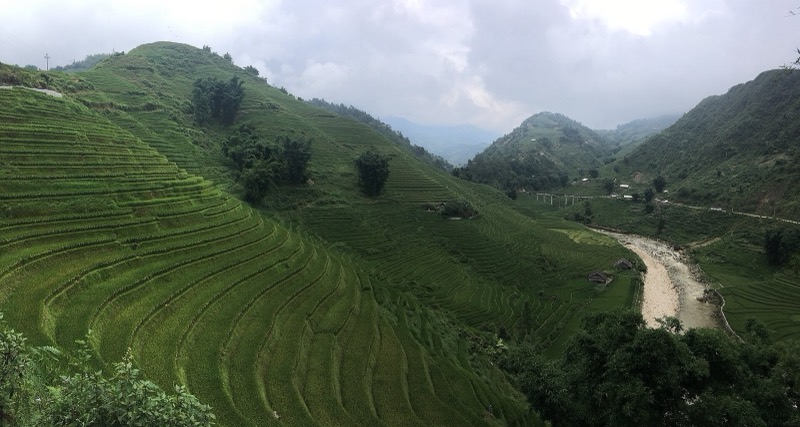
Mai Chau is a wide, flat valley floor built for gentle cycling, while Pu Luong is a nature reserve of steep terraces and forest. The table sets out the main differences.
| Mai Chau | Pu Luong | |
|---|---|---|
| Distance from Hanoi | About 135 to 140 km | About 145 to 180 km, depending on where you stay |
| Van time from Hanoi | About 3 to 3.5 hours | About 4 to 4.5 hours |
| Landscape | Flat rice valley ringed by limestone mountains | Terraced valleys inside a 17,662 ha nature reserve |
| What you do | Cycle between villages, browse weaving, sleep in a stilt house | Walk between villages, waterfalls and terraces, stay in a lodge |
| Places to stay on Booking.com (14 Oct 2026) | 86 | 16 |
| Province since July 2025 | Phu Tho | Thanh Hoa |
Distances come from Vietnamese Wikipedia, Baolau and Vietnam's tourism authority for Mai Chau, and from Baolau and 12Go for Pu Luong. The reserve's size comes from VnExpress.
Which province are they in now?
The two valleys sit in different provinces after Vietnam's 2025 reorganization. Hoa Binh province, which contained Mai Chau, merged with Phu Tho and Vinh Phuc into a new Phu Tho province from 1 July 2025, while Thanh Hoa, home to Pu Luong, was one of 11 provinces and cities left unchanged, per Tuoi Tre. Districts were abolished at the same time. Mai Chau is now a commune of about 148 square km formed from the old Mai Chau town and neighboring communes, per Vietnamese Wikipedia. In Thanh Hoa, a new commune named Pu Luong was formed from Thanh Son, Lung Niem and Thanh Lam, which belonged to the dissolved Ba Thuoc district, per Wikipedia. The nature reserve itself stretches further, across land that belonged to the old Ba Thuoc and Quan Hoa districts. Expect booking sites and drivers to use old and new names side by side.
How many days should you spend?
Give Mai Chau one or two nights and Pu Luong two. A good four-night loop runs like this: ride from Hanoi to Mai Chau and cycle the valley in the afternoon; spend a full day around Lac and Pom Coong villages; move on to Pu Luong, about 42 km away; walk there for a full day; then ride back to Hanoi. If you only have two nights, pick one valley rather than rushing both, since the Pu Luong leg alone is 4 hours or more each way from Hanoi.
What is there to do in Mai Chau?
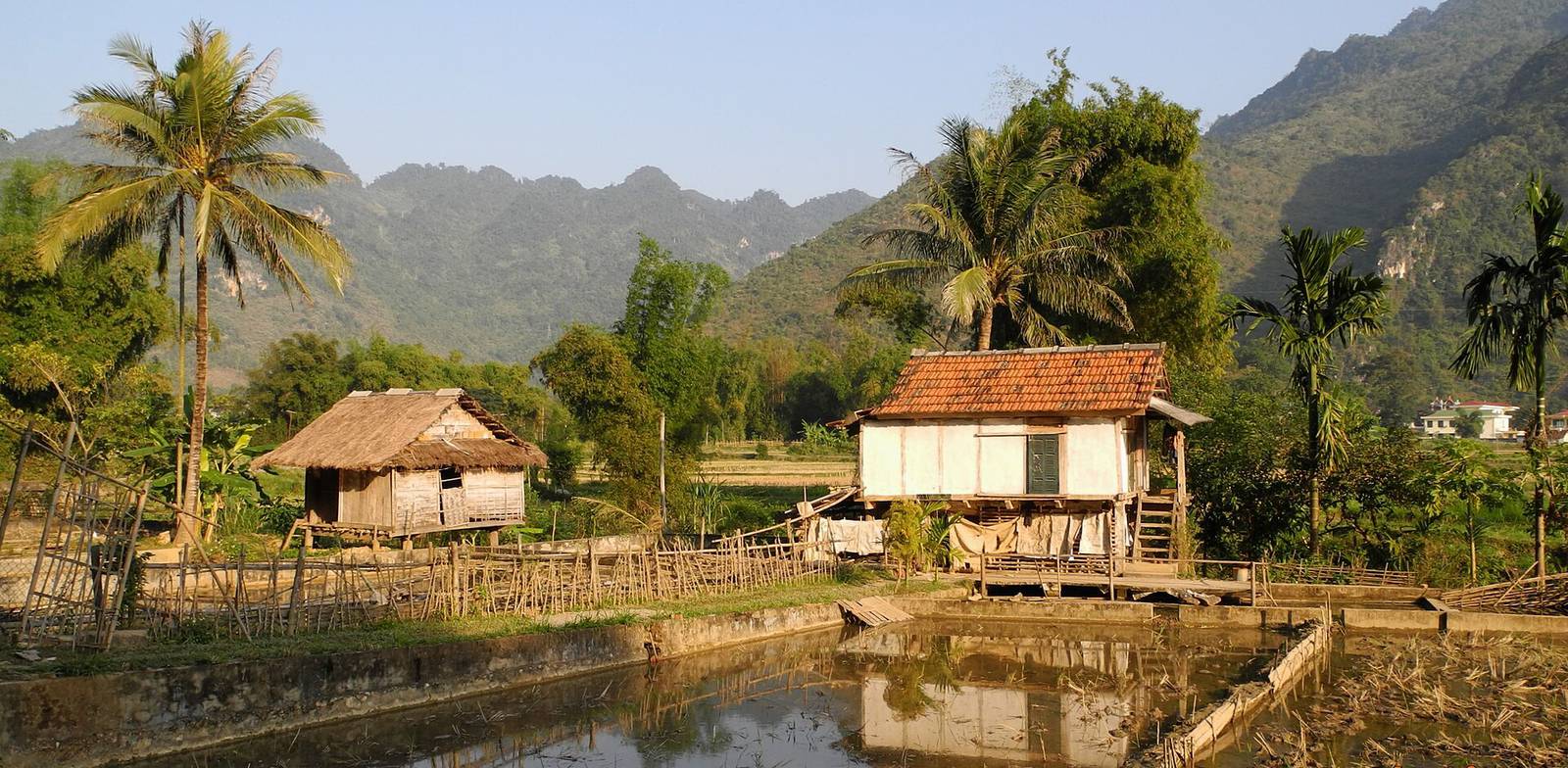
Mai Chau is about slow days on a bicycle and nights in a stilt house. Vietnam's tourism authority names Lac and Pom Coong as the two homestay villages, run by White Thai families, and recommends exploring the valley's paths by bicycle, with electric carts for hire too. Weaving is the local craft: the tourism authority mentions shopping for woven fabrics, and a 2025 press report profiles a weaving workshop in Pom Coong.
Tourism here is well established. In August 2025, Dai bieu Nhan dan counted 61 accommodation businesses in Mai Chau commune, 44 of them homestays in traditional stilt houses, and noted that ethnic minorities make up more than 90% of residents. Lac village alone had 80 households in the tourism business in early 2026, according to VCCI, which notes that Lac now sits in Mai Ha commune.
Tip: VCCI describes Lac's community tourism as one of the area's biggest draws. If you want a quieter night, look at homestays away from the main lanes and cycle in for dinner.
What is there to do in Pu Luong?
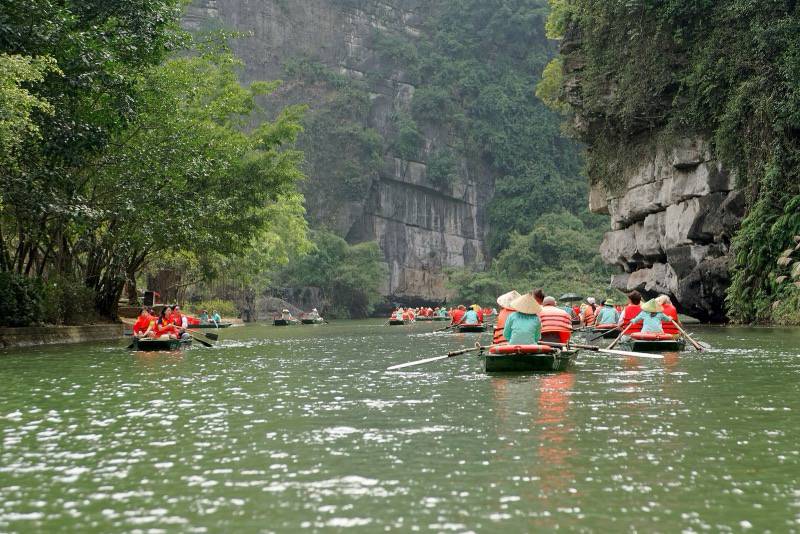
Pu Luong is for walking. The nature reserve was set up in 1999 and covers 17,662 ha, per VnExpress, whose guide (last updated in February 2025) lists Son Ba Muoi, Hieu village with its waterfall, Kho Muong village, Hang Doi (Bat Cave) and Don village among the main sights. The same guide notes a weekly market at Pho Doan on Thursdays and Sundays and bamboo raft rides for about 50,000 VND per person.
It is growing fast. In the first nine months of 2025, Pu Luong received more than 100,000 visitors, over 30,000 of them international, and the commune had close to 70 places to stay, VnEconomy reported. The same article counts more than 598 animal species in the area, 51 of them rare.
Do you need a guide in Pu Luong?
We found no rule requiring a guide in the sources we checked, and no ticket for entering the reserve itself; you pay for individual activities such as raft rides. For forest trails, or for walking in rain, a local guide is the safer choice, so ask your lodging about one when you book.
When are the rice fields green or golden?
Pu Luong is golden twice a year, from late May to mid-June and from late September to early October, per a June 2025 VnExpress report, and each spell lasts about two to three weeks. In Mai Chau, a 2024 VnExpress guide names May and June as the golden rice season, and Vietnam's tourism authority calls October perhaps the ideal month, when the harvest turns the valley gold.
Published normals for the valleys themselves are hard to find, so we use those for Hoa Binh city, the nearest city with published data, from the Vietnam Institute for Building Science and Technology.
| Months | Average low to high (Hoa Binh) | Rain (Hoa Binh) | In the valleys |
|---|---|---|---|
| December to February | About 14 to 23 degrees Celsius | 15 to 21 mm a month | Coolest and driest months |
| March to April | About 18 to 29 degrees Celsius | 35 to 96 mm a month | Warmer, rain starting to build |
| May to June | About 24 to 34 degrees Celsius | 244 to 270 mm a month | Golden rice in late May and June, rain rising |
| July to September | About 24 to 34 degrees Celsius | 286 to 325 mm a month | Wettest months; Pu Luong gold from late September |
| October to November | About 18 to 29 degrees Celsius | 55 to 184 mm a month | Harvest gold in October, rain tailing off |
For the national picture, see best time to visit Vietnam.
How bad is the rainy season?
The rain is heavy enough to change plans from May to September. Hoa Binh averages 244 to 325 mm a month in that period, against 15 to 21 mm in the driest months. Vietnam's tourism authority suggests avoiding June to August, when monsoon rains can flood local roads. The UK government's travel advice warns of flooding, swollen rivers and landslides in the rainy season. Trails in Pu Luong get muddy and slippery, so pack shoes with grip and a rain shell; our what to bring list covers the rest.
Where should you stay?
Stay in a village homestay in Mai Chau and a lodge or homestay with a view in Pu Luong. Prices below are nightly rates for two adults seen on Booking.com for 14 October 2026, unless noted.
| Area | Best for | Price seen | Trade-offs |
|---|---|---|---|
| Mai Chau homestays, many in Lac and Pom Coong | Stilt-house stays, bikes at the door, dinners with the family | From about 176,000 VND; many well-reviewed ones 230,000 to 330,000 VND | The most visited part of the valley |
| Mai Chau resorts | More comfort and privacy | About 1.1 million to 4 million VND in a 2024 guide | Further from village life |
| Pu Luong homestays | Village life, lower prices | About 231,000 to 583,000 VND | Simple rooms, steep access roads |
| Pu Luong eco-lodges | More comfort, views over the valleys | About 1.2 million to 2.5 million VND, with one listing above 5 million | Spread out, so you rely on the lodge for transport |
The Mai Chau resort range comes from a 2024 VnExpress guide, which priced three resorts at about 1.1 million to 4 million VND a night depending on the day.
How do you get there, and between the valleys?
Take a limousine van from the Old Quarter. On Baolau, a van to Mai Chau took 3 hours 5 minutes for 250,000 VND on 9 October 2026, and vans to Pu Luong took 4 hours 30 minutes for 360,000 to 400,000 VND, arriving at company offices in the former Ba Thuoc district. Between the two valleys, 12Go puts the distance at 42 km and the trip at 1 to 2 hours, with a shared car at about $19 per person and private cars from about $34 per vehicle. Compare every option, including private cars and the Thung Khe pass, on Hanoi to Mai Chau and Pu Luong, and onward trips on Starting from Hanoi.
How do you get around?
Use a bicycle in Mai Chau and arrange transport through your lodging in Pu Luong. Vietnam's tourism authority recommends bicycles for exploring Mai Chau's valley, with electric carts as an option. Pu Luong's sights are spread across a 17,662 ha reserve, so plan rides between villages with your lodging. If you plan to rent a motorbike, read our getting around Vietnam page on licenses first.
How much does a trip cost?
The valleys are cheap, and your choice of lodging is the biggest variable. We converted at about 26,000 VND to US$1, between Vietcombank's published USD buying and selling rates (25,760 and 26,170) when we checked on 3 October 2026.
| Item | Price in VND | About in USD | Where we saw it |
|---|---|---|---|
| Van, Hanoi to Mai Chau | 250,000 | $9.60 | Baolau, for 9 Oct 2026 |
| Van, Hanoi to Pu Luong | 360,000 to 400,000 | $14 to $15 | Baolau, for 9 Oct 2026 |
| Shared car, Mai Chau to Pu Luong | about 495,000 | $19 | 12Go, for 14 Oct 2026 |
| Homestay, Mai Chau, room for two | from about 176,000 | from $7 | Booking.com, 14 Oct 2026 |
| Homestay, Pu Luong, room for two | from about 231,000 | from $9 | Booking.com, 14 Oct 2026 |
| Eco-lodge, Pu Luong, room for two | about 1.2 to 2.5 million | $47 to $97 | Booking.com, 14 Oct 2026 |
| Bamboo raft ride, Pu Luong | about 50,000 | $1.90 | VnExpress, Feb 2025 |
What food is worth trying?
Eat what your host family cooks. VCCI's report on Mai Chau's homestays describes sticky rice, grilled meat and bamboo-tube rice among the Thai and Hmong dishes served to guests, alongside cultural performances. Ask whether your rate includes dinner and breakfast before you compare prices.
What safety issues are specific to the valleys?
Roads and rain cause more trouble than crime here. Our Vietnam safety page covers the general picture.
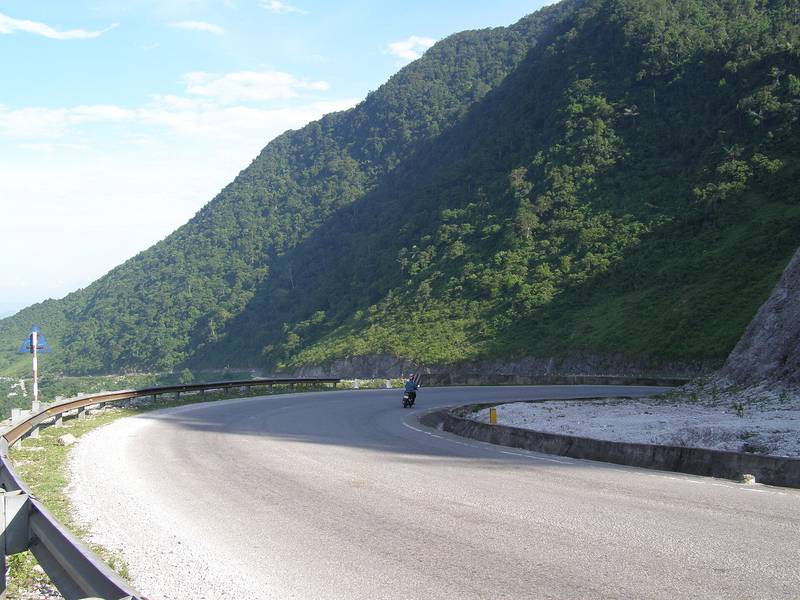
- Mountain roads: the drive crosses the Thung Khe pass, where Bao Lao Cai notes that evening fog makes the road hard to drive. Travel in daylight when you can.
- Rain: May to September brings heavy rain, and the UK government warns of landslides and floods in the rainy season.
- Motorbikes: the same advice calls motorbike travel in Vietnam much riskier than in the UK. On Pu Luong's steep roads, a driver is the safer choice.
- Trails: carry water and tell your host where you are walking, especially on forest paths.
Key facts at a glance
- Provinces: Mai Chau in Phu Tho and Pu Luong in Thanh Hoa since 1 July 2025 (Tuoi Tre).
- Pu Luong Nature Reserve: set up in 1999, 17,662 ha (VnExpress).
- Golden rice in Pu Luong: late May to mid-June and late September to early October (VnExpress).
- Van fares from Hanoi: 250,000 VND to Mai Chau, 360,000 to 400,000 VND to Pu Luong, for 9 October 2026 (Baolau).
- Between the valleys: about 42 km, 1 to 2 hours (12Go).
- Visitors: more than 100,000 to Pu Luong in the first nine months of 2025 (VnEconomy).
Limitations
Fares and room prices are listings seen on 3 October 2026 for travel on 9 and 14 October, and they change with dates and demand; Booking.com shows only part of the market, especially in Pu Luong. The Pu Luong guide we used for sights, the market days and the raft price was last updated in February 2025, and the Mai Chau resort prices date from 2024. Harvest timing varies by village, altitude and year. Climate figures come from Hoa Binh city, not the valleys themselves, so treat them as a guide to rain patterns rather than exact temperatures. Administrative names are still settling after the 2025 mergers. Before you go, confirm your van's drop-off point, ask your lodging whether meals and transfers are included, and check the forecast for heavy rain.