Pack for two countries, because that is what Vietnam's weather feels like. A December trip can mean a down jacket in Hanoi and shorts in Ho Chi Minh City in the same week. Start with where you are going and when, then add the few things that are hard to buy locally: your medicines, a plug adapter and the right documents.
How we built this guide: we pulled 1991 to 2020 climate normals from the World Meteorological Organization for Hanoi, Lao Cai, Da Nang and Ho Chi Minh City, and checked the UK, Australian and US government pages on dress, medicines, customs and banned items on 2 October 2026. Plug types and voltage come from two references that do not fully agree, and we say where.
What is the weather like where I am going?
Vietnam has a cool-winter north and a hot south, with a rainy central coast in autumn. These are average daily temperatures and rain from WMO normals (Hanoi, Lao Cai, Da Nang, Ho Chi Minh City).
| City | January low to high | July low to high | Wettest months (average rain) |
|---|---|---|---|
| Hanoi (north) | 14.6 to 20.0°C | 26.5 to 33.3°C | August 335 mm, July 300 mm |
| Lao Cai (north, valley town below Sapa) | 14.5 to 20.2°C | 26.0 to 33.2°C | August 374 mm, July 304 mm |
| Da Nang (center) | 19.7 to 25.2°C | 26.0 to 34.4°C | October 658 mm, November 486 mm |
| Ho Chi Minh City (south) | 23.4 to 32.0°C | 25.2 to 33.0°C | September 273 mm, October 240 mm |
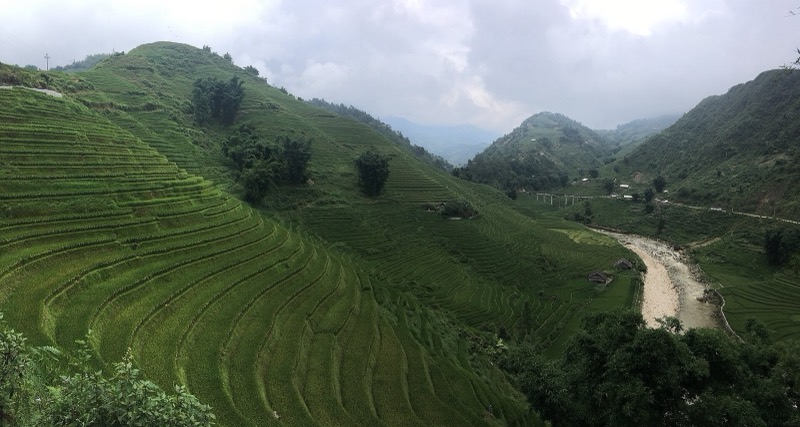
Sapa itself is far cooler than the Lao Cai valley figures above. Wikipedia's Sa Pa article, citing a 2006 study, puts average temperatures at about 15 to 16°C and says winter temperatures occasionally fall below freezing (Wikipedia). Treat that as a rough guide rather than official data.
What clothes should I pack?
Pack light, quick-drying clothes as the base and add layers for the north. Here is how the regions differ:
- North in winter (December to February): a warm jacket, a fleece or sweater and long pants for Hanoi, Ha Long and Ninh Binh. For Sapa, add a hat, gloves and warm socks. See our Sapa guide.
- North in summer (May to September): breathable shirts and shorts, but it is hot and wet, so a rain jacket and shoes that cope with puddles.
- Center (Hue, Hoi An, Da Nang): summer clothes most of the year, plus proper rain gear from September to December, when Da Nang's rainfall peaks.
- South (Ho Chi Minh City, Mekong Delta): hot-weather clothes all year, sun protection, and an umbrella or poncho for the May to October rains.
For temples, pagodas and other religious or cultural sites, cover your shoulders and knees; the UK government says signs outside often state the dress code (FCDO). A light scarf and a pair of long pants in your day bag cover most cases.
Do I need rain gear?
Yes, for most of the year somewhere in the country. The UK government says the rain season runs from June to September in the north and south and from October to December in central Vietnam, with seasonal flooding in the center in October and November (FCDO). A packable rain jacket, a cover for your daypack and a small dry bag for your phone and passport are worth the space. Smartraveller asks travelers to keep passports and important papers safe and dry during storm season (Smartraveller).
Which plugs and voltage does Vietnam use?
Most sockets take Type A and Type C plugs, at about 220 V and 50 Hz. The University of Warwick's guide for the AAMAS 2027 conference in Vietnam lists 220 V at 50 Hz, Type C as the most widespread socket, Type A in some hotels and the three-pin Type D as less common (University of Warwick). WorldStandards lists Types A, B and C at 230 V and 50 Hz (WorldStandards). The practical answer is the same either way.
| Your plugs | Will they fit? | What to bring |
|---|---|---|
| Continental European (round pins) | Usually, Type C | Nothing, or a spare adapter |
| US, Canada, Japan (flat pins) | Type A sockets yes; Type C no | A universal adapter; check the voltage label |
| UK, Singapore, Hong Kong | No | An adapter |
| Australia, New Zealand | No | An adapter |
Check the small print on each charger. Anything marked 100 to 240 V works in Vietnam with an adapter, while a device rated for 110 to 120 V only needs a voltage converter as well, as Warwick's guide notes.
What medicines and health items should I bring?
Bring every medicine you need for the whole trip, in carry-on luggage with a copy of the prescription. The UK government warns that some medicines are hard to find in Vietnam and many are fake, and that medicines Vietnam classes as addictive or psychotropic are limited to seven days' supply, with a doctor's letter recommended (FCDO health). Prescription medicines worth more than US$100 must be declared at customs (FCDO entry requirements).
Add an insect repellent with at least 20% DEET, which CDC recommends against mosquito-borne diseases (CDC), sunscreen, a hat for the south and a small first-aid kit. Our vaccinations and health guide covers vaccines and clinics.
Should I get a SIM card or eSIM?
A local SIM or eSIM makes ride-hailing apps, maps and messaging far easier. Whichever you choose, Vietnam requires the line to be registered to your identity: under Decree 163/2024/ND-CP, foreigners register with a passport valid for their permitted stay, or an electronic ID account (Bao Phap Luat). Make sure your phone is unlocked before you leave home, and keep your passport handy when you buy.
What should I not bring?
A short list of items can get you fined, confiscated or worse:
- Vapes and e-cigarettes. Banned; you cannot buy them in Vietnam or bring them in (FCDO and Smartraveller).
- Any illegal drugs, including cannabis. Penalties include long prison terms and the death penalty (FCDO).
- A drone, unless you have planned for it. From 20 July 2026, Circular 78/2026/TT-BCA requires every drone in Vietnam to be registered and to carry an identification code and flight-management device, and foreign individuals must meet extra conditions (Doanh nghiep Hoi nhap). Ask a Vietnamese embassy before you pack one.
- Large amounts of undeclared cash. Declare more than 15 million VND or US$5,000 (or the equivalent) on arrival or departure (FCDO entry requirements).
- Political or religious material that is not state sanctioned (Smartraveller), and protected wildlife products as souvenirs on the way home (FCDO). Smartraveller adds that exporting antiques needs a permit.
What documents should I carry?
Keep your passport in the hotel safe and carry photo ID; the UK government says a printed copy of your passport photo page and visa is accepted. Smartraveller says you may be asked to show a printed copy of your e-visa at check-in and on arrival, and that you need the same passport you entered with for domestic flights and hotels. Also pack your insurance details, digital copies of everything, and, if you plan to drive, the license paperwork described in our safety guide. Our visa guide covers entry rules.
Key facts at a glance
- Hanoi's January averages run from 14.6°C at night to 20.0°C by day (WMO).
- Da Nang's wettest month is October, with 658 mm of rain on average (WMO).
- Supply is 220 V, 50 Hz, with Type C sockets most widespread and Type A in some hotels (University of Warwick).
- Vapes are banned and cannot be brought into Vietnam (FCDO).
- Declare cash above 15 million VND or US$5,000 (FCDO).
- Drones must be registered with an identification code from 20 July 2026 under Circular 78/2026/TT-BCA (Doanh nghiep Hoi nhap).
Limitations
Climate normals are 30-year averages, and any single week can be colder, hotter or wetter, so check a forecast a few days before you pack. Our two electrical references disagree on the third socket type and on 220 versus 230 V, so a universal adapter is the safe choice. The drone rules are new and we read them in a news summary rather than the circular itself, and the Sapa temperatures come from Wikipedia rather than an official station. Customs limits and banned items can change, so confirm with your airline and a Vietnamese embassy before you travel.