Good manners in Vietnam come down to modesty, calm and respect for older people. Dress modestly at pagodas and temples, take off your shoes where others do, greet the oldest person first and keep your voice down when something goes wrong. Those basics cover most situations a visitor meets.
How we built this guide: on 3 October 2026 we read Vietnam's national tourism board's advice on etiquette and payments, Hue's heritage-site visitor rules as reported in July 2026, the UK, Australian, Canadian and US governments' guidance on local laws, customs and LGBTQ travelers, and the Cultural Atlas entries on Vietnamese etiquette, greetings and names. Customs vary by region, generation and family, so treat this as a starting point and follow the lead of the people around you.
What should I wear and do at a pagoda or temple?
Cover your shoulders and knees, take off your hat, and remove your shoes wherever others have. The UK government says dressing appropriately at religious or cultural sites usually means covering shoulders and knees, and that signs at the entrance often spell out the dress code. Vietnam's tourism board adds that you should always remove shoes and hat in temples, though you can carry your shoes with you (Vietnam Tourism).
Some sites enforce this. In July 2026 the Hue Monuments Conservation Center set out its visitor rules for the former imperial capital: no shorts, short skirts or bare-shoulder tops in the inner shrine areas, hats off and quiet in sacred spaces, and no touching artifacts or sitting on historic structures. Guards can end the visit of anyone who breaks the rules, according to Bao Van Hoa. Our Hue guide covers tickets for the Citadel and tombs.
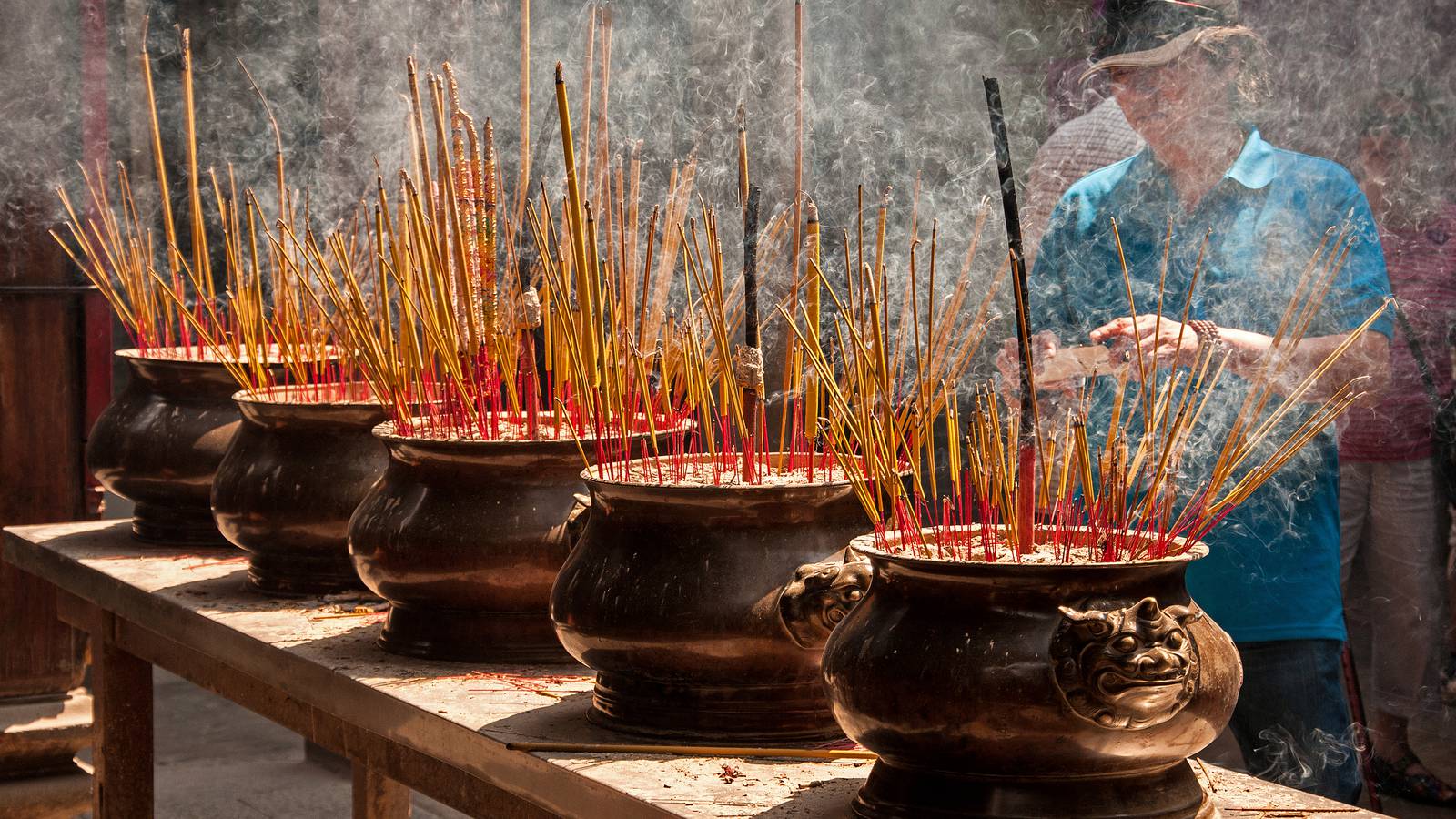
A few quieter customs are worth knowing. The Cultural Atlas notes that incense is generally lit for rituals, anniversaries, mourning or in temples, and that women traditionally do not touch Buddhist monks (Cultural Atlas). Families also keep altars in homes and shops, some at floor level, and the tourism board asks visitors not to step over them or walk directly in front of them.
Can I take photos inside?
Check for a sign first, and be discreet. Canada's advice is to dress conservatively, behave discreetly and seek permission before photographing local people at religious and cultural sites (Government of Canada). Hue's rules ban drones and require advance permission for filming. We suggest keeping your camera away from people praying, and asking a monk or caretaker if you are unsure.
Where do the rules change? A quick reference
Most situations fall into five settings. This table pulls the official advice together.
| Setting | Do | Avoid | Source |
|---|---|---|---|
| Pagoda or temple | Cover shoulders and knees; hat off; shoes off where others do | Shorts, short skirts, bare shoulders; touching artifacts | FCDO, Hue monuments rules |
| Someone's home | Shoes off outside; greet the oldest first; bring fruit, biscuits or flowers | Stepping over a floor altar; anything black as a gift | Vietnam Tourism |
| Shared meal | Pass dishes with both hands or the right hand; say you are full to stop | Chopsticks standing upright in rice | Vietnam Tourism, Cultural Atlas |
| Market stall | Ask at a few stalls, then negotiate gently | Haggling where prices are fixed | Vietnam Tourism |
| Street and public places | Stay calm and quiet; ask before photos | Shouting, public displays of affection, going shirtless away from the beach | Vietnam Tourism |
How should I greet people and use names?
Say "xin chao" (hello), greet the oldest person first, and expect to be asked your age. The Cultural Atlas says people are greeted in order of age, that men usually shake hands with a small nod, and that women more often nod or bow briefly, so wait for a woman to offer her hand first (Cultural Atlas). With Buddhist monks and nuns, a respectful bow replaces the handshake. "How old are you?" is not rude: knowing your age tells people which word for "you" to use.
Names run the other way from English. A Vietnamese name is usually family name, then middle name, then given name, so Nguyen Van Nam's given name is Nam, and women keep their own names when they marry (Cultural Atlas). People are addressed by the given name plus a family-style title. The tourism board lists the common ones for getting attention politely: "em oi" for someone younger, "chi oi" for a woman a little older, "anh oi" for a man a little older, "co" or "chu" for a woman or man of your parents' age, and "ba" or "ong" for grandparents' age. If in doubt, "ban oi" means "hey, friend" (Vietnam Tourism).
What are the table manners?
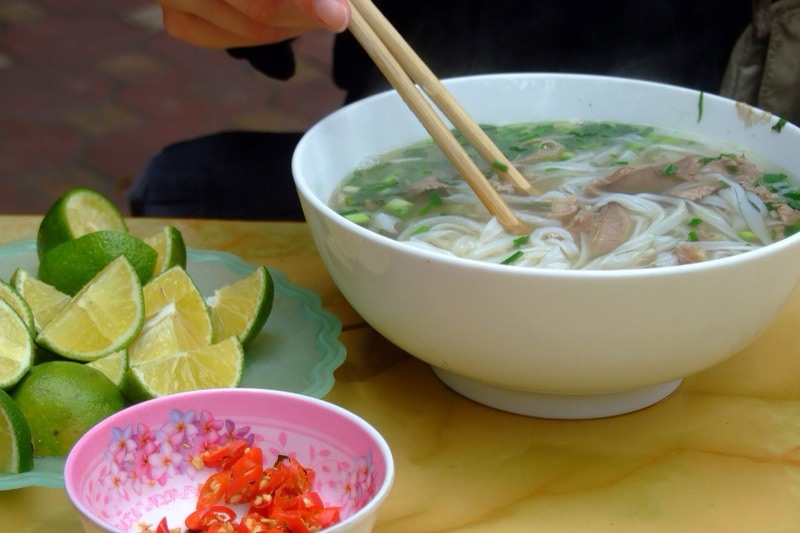
Meals are shared, so the main rules are about passing food and pacing yourself. The tourism board describes the usual spread of shared dishes with a small rice bowl and chopsticks for each diner. Pass dishes with both hands or your right hand, not the left, and hold your spoon in your left hand when eating soup. Hosts will keep refilling your glass and putting the best pieces in your bowl; to stop, repeat politely that you are full. The person who invited everyone, or otherwise the most senior person, usually pays.
Two more points from the Cultural Atlas: never rest your chopsticks upright in a bowl of rice, because it looks like incense burned for the dead, and expect a cook to play down their food, which is your cue to compliment it. Our guide to what to eat in Vietnam covers the dishes themselves.
What gifts are appropriate?
Something small and edible is the safe choice. When you visit a family home, the tourism board suggests biscuits or cake, fruit, flowers or soft drinks, and never anything black. The Cultural Atlas adds handkerchiefs, yellow flowers and chrysanthemums to the list to avoid, as possible bad omens. Give and receive gifts, and most other objects, with both hands. Do not be surprised if a Vietnamese friend calls their own present unworthy: the Cultural Atlas says modesty about gifts is normal.
Should I bargain, and should I tip?
Bargain gently in markets and do not tip out of obligation. The tourism board says bargaining is common in casual shopping hubs and markets, that you can usually get a reduction in tourist areas through some gentle negotiation, and that it helps to ask at a few shops first to get a sense of the price (Vietnam Tourism). Keep it light and friendly; a heated haggle over a few thousand dong costs the seller face and you goodwill. Where prices are fixed, as in supermarkets, malls and app-booked rides, there is nothing to negotiate. Our Grab and taxi guide explains how app fares work.
On tipping, the same tourism board page says there is no set rule because tipping is not a normal part of Vietnamese culture, and that it is not expected in restaurants and cafes. It is your choice. Our money guide covers cash, cards and daily costs.
How should I behave in public?
Stay calm, keep affection private and dress for the place you are in. The tourism board explains the idea of saving face: avoid loud arguments, making a scene or criticizing someone for a mistake in front of others. It also says many Vietnamese dislike public displays of affection, that men should not be seen shirtless in public, and that swimwear belongs on the beach or at your resort. Outside the big cities, people tend to be more traditional and modest. The Cultural Atlas similarly advises against raising your voice or showing anger in public.
Laws that look like etiquette
A few rules that visitors treat as manners are actually law:
- Photos of military sites and border areas. Smartraveller says photographing them is illegal, and the FCDO advises against taking photos near bases.
- Images linked to the former Republic of Vietnam. Smartraveller says possessing or distributing them, including commemorative or war-related items, is an offense that could attract harsh penalties.
- Politics and religion. The FCDO urges caution over political activity such as criticizing the government, says possessing political material or unsanctioned religious activity such as proselytizing could lead to a travel ban or prison, and advises avoiding all protests.
- Hotel guests. Canada says foreigners are not allowed to invite Vietnamese nationals of the opposite sex to stay overnight in their hotel room unless married.
Why should I not touch heads or point at people?
Because the head is the most respected part of the body and the feet the least. The Cultural Atlas says touching someone on the top of the head, especially a baby or child, is rude, and that you should not pass things over another person's head. Feet are considered the dirtiest part of the body, so do not point the soles of your feet at anyone or at an altar. The tourism board also warns against pointing at people and patting them on the back or head, especially older people, and notes that the Western "fingers crossed" gesture is highly impolite in Vietnam.
What changes during Tet and at funerals?
Tet, the Lunar New Year, reshapes daily life for several days, and funerals follow their own visible customs. Canada notes that Tet celebrations usually last several days and can affect banking, public services, transport and food distribution. Our Tet guide covers the dates, what closes, and the customs around visiting homes and lucky money.
A funeral usually begins at the family home, where the body stays for about three days, and you may meet a procession in the street. Mourners traditionally wear white, not black: Wikipedia's articles on Vietnamese funerals and Vietnamese culture describe white mourning clothes and headbands, votive paper dropped along the route of a procession, and further rites after 49 and 100 days. If you pass one, give way, lower your voice and do not photograph the mourners.
Is Vietnam welcoming to LGBTQ travelers?
Largely yes, with restraint in public. The FCDO calls Vietnam a generally tolerant and progressive place for LGBT+ travelers, says there are no criminal penalties for same-sex sexual activity or changing gender, and notes that same-sex marriage is not recognized in law. The US State Department says there are no legal restrictions on same-sex relations or on attending LGB events. Smartraveller adds that social attitudes can be conservative, especially in rural areas, that same-sex partners are not legally protected or recognized, and that travelers should avoid public displays of affection, advice that the tourism board gives to every couple.
Key facts at a glance
- Covering shoulders and knees is the usual dress code at religious and cultural sites (FCDO).
- Hue's heritage sites ban shorts, short skirts and bare-shoulder tops in inner shrine areas, per rules reported on 16 July 2026 (Bao Van Hoa).
- Tipping is not a normal part of Vietnamese culture and is not expected in restaurants (Vietnam Tourism).
- There are no criminal penalties for same-sex sexual activity, but same-sex marriage is not recognized (FCDO).
- Possessing images or objects linked to the former Republic of Vietnam is an offense (Smartraveller).
Limitations
Etiquette is a set of habits, not a rulebook, and it differs between north and south, city and village, and young and old Vietnamese. The Cultural Atlas was written mainly for Australians meeting Vietnamese communities, so some of its points may matter less in a busy tourist area. Our funeral customs come from Wikipedia, and site rules other than Hue's were not checked one by one, so read the sign at each gate. Government advice on laws and LGBTQ travel can change; check your own government's current page before you go.