Kon Tum is the quiet end of the Central Highlands, a small riverside city where a wooden cathedral, a French-era seminary and Bahnar villages sit within walking distance of each other. Two or three days is enough: one for the city, one for the pine forests and waterfalls of Mang Den, and a third if you want to go further along the Ho Chi Minh Road. Come between November and April, when the rain stops.
How we built this guide: on 19 October 2026 we checked VnExpress's Kon Tum guide (2024) and Mang Den guide (updated February 2026), 2025 visitor guides to the cathedral and the Bishop's House, Vietnamese Wikipedia's climate table, 2025 and 2026 press reports on rong houses, Mang Den and Highway 24, the National Assembly's 2025 merger resolution as reported by Tuoi Tre, room prices on Booking.com and flights to Pleiku on Google Flights for 6 November 2026. We did not visit Kon Tum for this update.
Where is Kon Tum, and what changed in 2025?
Kon Tum sits in a basin of the Dak Bla River at about 525 m above sea level, roughly 292 km south of Da Nang and 547 km north of Ho Chi Minh City, per Wikipedia. The name means "village by the lake" in the Bahnar language, the same article says, and French missionaries have been here since the mid-19th century.
The map changed in 2025. The National Assembly voted on 12 June 2025 to merge Kon Tum and Quang Ngai into a new province named Quang Ngai, with its center in the old Quang Ngai, and the new provinces began operating on 1 July 2025, per Tuoi Tre. Kon Tum city became Kon Tum ward, with 77,456 people in 2025, per Wikipedia. Signs, tickets and booking sites may show either the old or the new names.
The Central Highlands' indigenous cultures are what set Kon Tum apart. Ethnic minorities made up more than 54 percent of the old province's population, with seven native groups including the Xo Dang (Sedang), Bahnar, Jrai, Gie-Trieng, Ro Mam, Brau and Hre, Viet Nam News reported in April 2025.
How many days should you spend in Kon Tum?
Plan two full days at least, and three or more for a slower trip, as Local Vietnam also advises. A simple plan:
- Day one: the wooden cathedral, the Bishop's House, then Kon Klor's rong house and suspension bridge by the Dak Bla.
- Day two: Mang Den, about 60 km north-east, for Pa Sy waterfall, Dak Ke lake and Khanh Lam pagoda.
- Day three: a Xo Dang village near Mang Den, or north on the Ho Chi Minh Road toward the border.
Is the wooden cathedral worth seeing, and what are the rules?
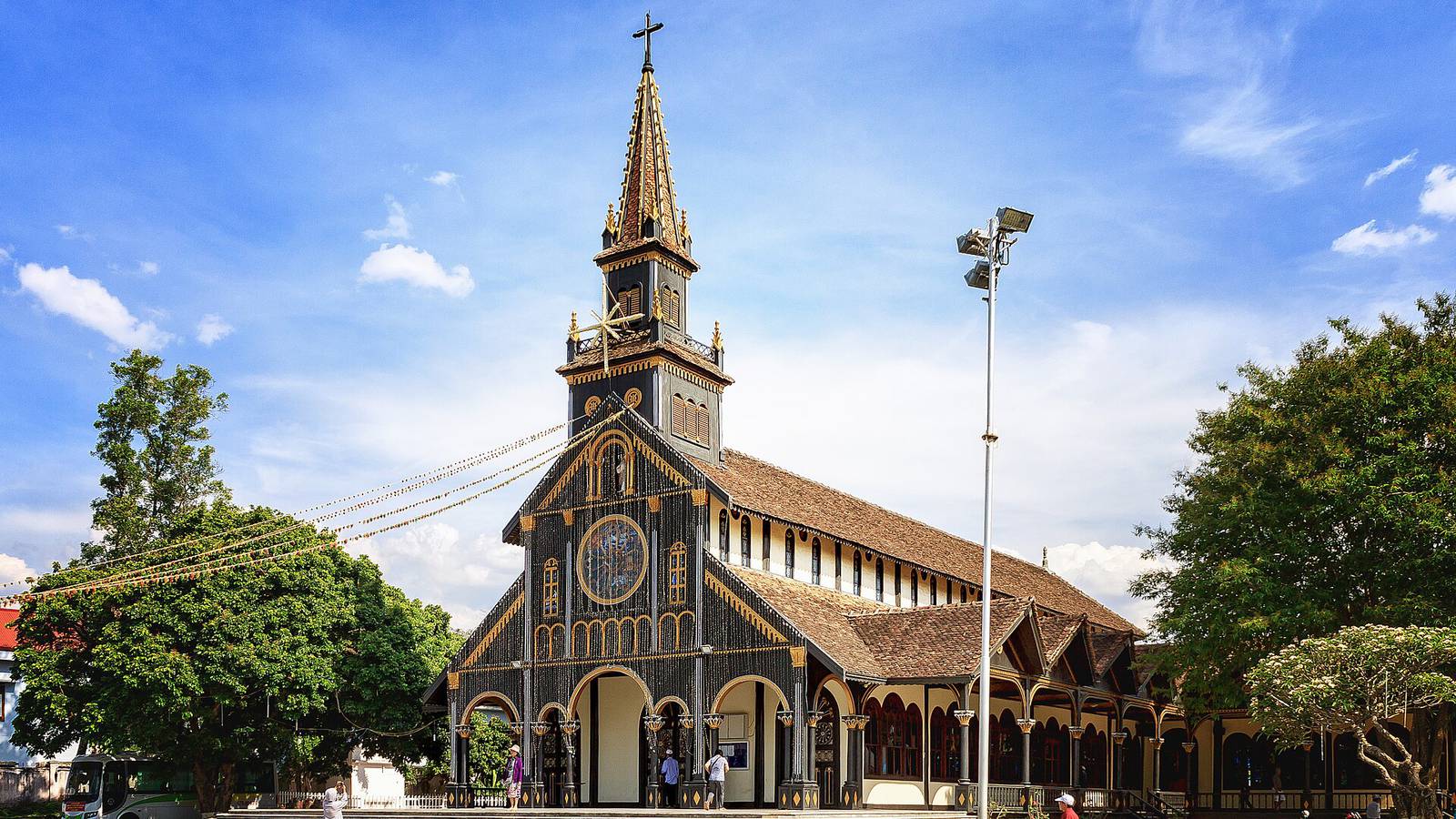
Yes; it is the reason most people stop in Kon Tum, and it is still a working cathedral. VnExpress describes Romanesque lines combined with the style of a Bahnar stilt house, built from 1913 to early 1918 entirely in ca chit hardwood, with walls of earth mixed with straw instead of reinforced concrete. Inside, rows of slim columns joined by wooden arches hold up the upper windows, and stained glass shows Bible stories alongside scenes of Central Highlands life.
A 2025 guide on mia.vn dates construction from 7 April 1913 to 6 January 1918 under Father Joseph Decrouille, gives the address as 13 Nguyen Hue street, and notes a four-tier bell tower more than 20 m high and a statue of the Virgin Mary dressed as a Bahnar woman with a basket on her back.
| Visiting the cathedral | What the 2025 guide says |
|---|---|
| Sunday Mass | 05:00, 07:30 and 16:00 |
| Weekday Mass | 05:00 and 17:30 |
| Best time for visitors on Sundays | After 09:00 |
| Dress | Modest clothing, nothing too short or revealing |
| Photos | Allowed inside and outside, but not during Mass |
Mass times can change for feast days, so read the board at the gate. Neither guide we read lists an entry fee.
Is the museum at the Bishop's House open?
It was in 2025, except on Tuesdays. The Bishop's House, a large timber building from 1935 that mixes local and Western architecture, keeps a traditional house that works as a small museum of daily objects, farm tools and cultural items of the local ethnic groups, per VnExpress, which says it closes on Tuesdays and opens the rest of the week. Wikipedia calls it a large French-built seminary hosting a small museum on the local hill peoples.
A 2025 guide on mia.vn places it at 146 Tran Hung Dao street, near the cathedral, and gives hours of 07:30 to 11:00 and 14:00 to 17:00 from Wednesday to Sunday, with Tuesday closed. It reminds visitors that this is a religious house rather than a tourist site: stay in the front courtyard, not the back, do not use it as a wedding photo backdrop, and dress modestly. We could not confirm 2026 hours with the Diocese of Kon Tum.
How do you visit Bahnar and Sedang villages and their rong houses?
Start at Kon Klor, on the edge of the city, and go further out with a local guide. A rong house is the tall thatched communal house at the heart of a village. A Vietnam Law and Legal Forum profile of the Bahnar describes it as the place for village meetings, young people's gatherings, rites and guests' lodging, and historically for judging breaches of customary law; a drum and a sacred stone are installed at one gable as the village's guardian, and a council of elders runs village affairs (Vietnam Law and Legal Forum, 2011). In April 2025 the old province had 503 ethnic villages but only 479 rong houses, per Viet Nam News.
| Village or site | Group | Where | What you see | Source |
|---|---|---|---|---|
| Kon Klor | Bahnar | Tran Hung Dao street, Kon Tum ward | One of the largest rong houses in the Central Highlands, next to Kon Klor suspension bridge over the Dak Bla | VnExpress, 2024 |
| Kon K'tu | Bahnar | Along the Dak Bla near Kon Klor | Stilt houses and traditional village life | VnExpress, 2024; Local Vietnam, 2025 |
| Kon Pring | Not stated in our source | Mang Den commune, among pine hills | Homestays and village life near Mang Den | SGGP, February 2026 |
| Vi Ro Ngheo | Xo Dang (Sedang) | Dak Tang, about an hour by car from Mang Den on provincial road 676 | 63 households, orchids grown around the houses, recognized as a community tourism village | Bao Van Hoa, 2023 |
VnExpress says Kon Klor's rong house is built in the traditional way from wood, bamboo and thatch with elaborate carved patterns, and that villagers and craftsmen keep it as the pride of the Bahnar community. The suspension bridge beside it leads across the river to fields and gardens. Bao Van Hoa reported in 2023 that all of Vi Ro Ngheo's 300-plus residents are Xo Dang and called it the only village that still keeps its original Xo Dang character.
Etiquette in a village
We found no published visitor rulebook for rong houses, so these are our suggestions based on what the sources say the house means to a village:
- Ask before you climb the steps into a rong house, and follow a villager or your guide.
- Leave the drum, the gongs and any ritual objects alone, since the house holds the village's guardian.
- Ask before photographing people, as our etiquette page advises everywhere in Vietnam.
- Dress modestly and keep your voice down if a meeting or ceremony is under way.
What is there to do in Mang Den?
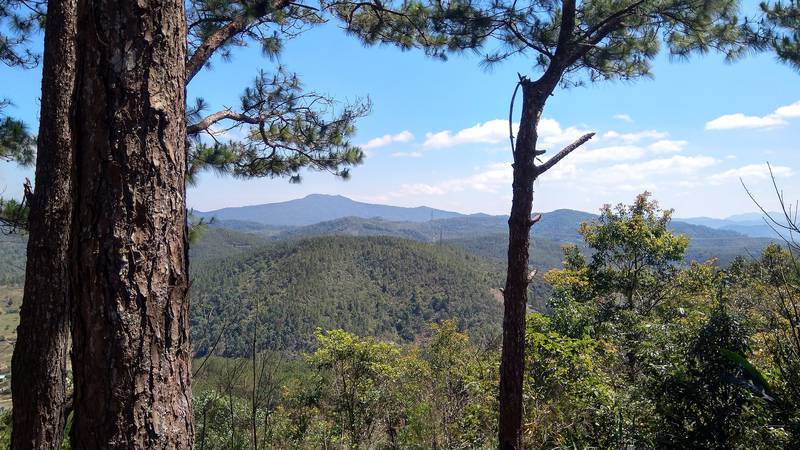
Mang Den is the cool, pine-covered plateau that makes the trip worthwhile for many visitors. It sits at about 1,200 m, about 60 km north-east of Kon Tum ward, and the French planted pines there in the early 20th century with a hill station in mind, per Vietnamese Wikipedia, which says it is planned as a national eco-tourism area. VnExpress's Mang Den guide, updated in February 2026, lists:
- Pa Sy waterfall: the center of a 25 ha eco-tourism site with paths, a rong house and a craft workshop. VnExpress puts the falls at about 1,500 m and says the name means three streams joining into one.
- Dak Ke lake: about 3 ha in the middle of town, with rowing and pedal boats.
- Khanh Lam pagoda: at about 1,200 m, reached by more than 200 stone steps, with a 17 m statue of the bodhisattva Quan Am.
- The wooden statue garden: built in 2013 near Pa Sy, with 100 carvings of daily life by 33 local ethnic craftsmen.
- Farms: fruit and vegetable farms that VnExpress says charge no entry fee; you pay for what you pick.
Mang Den gets busy at holidays. Over the April 30 and May 1 break in 2026 it received about 65,000 visitors, Bao Van Hoa reported, and VnExpress names October to December as the busiest season, with cherry blossoms around the New Year. Book rooms ahead for weekends and holidays. SGGP highlights Kon Pring community tourism village among the pine hills as a calmer base.
Watch out: the road up to Mang Den is steep and winding, VnExpress warns, and Highway 24 between Mang Den and the coast is narrow and slide-prone. Floods in late October and November 2025 cracked and cut it in places around Mang Den and the Vi O Lak pass, Tuoi Tre reported in January 2026. Ride or drive only in daylight, and only if you are experienced; see renting a motorbike in Vietnam.
What lies along the Ho Chi Minh Road from Kon Tum?
National Road 14, the Ho Chi Minh Road, is Kon Tum's link north to the Lo Xo pass and Da Nang; night buses from Da Nang list stops at Ngoc Hoi and Dak Ha on the way into town, per Vexere. VnExpress points to three trips north and west of the city:
- The Indochina junction: the three-country border marker for Vietnam, Laos and Cambodia stands on a 1,086 m hill about 15 km from Plei Kan in Ngoc Hoi and 75 km from Kon Tum, near the Bo Y international border gate, which VnExpress says is open from 07:00 to 19:30 every day.
- Ngoc Linh mountain: about 2,600 m high, known for Ngoc Linh ginseng.
- Chu Mom Ray National Park: about 30 km from the city, home to the Brau and other small groups. Local Vietnam says some zones need permits or local guides.
If you plan to cross into Laos at Bo Y, first check that the gate is on the official list of land crossings that accept Vietnam's e-visa, which our Vietnam visa page explains.
When is the best time to visit Kon Tum?
November to April, when the rain nearly stops. The climate table on Vietnamese Wikipedia, citing the Vietnam Institute for Building Science and Technology, shows that the rainy season from May to October brings about 90 percent of the year's 1,771 mm.
| Months | Rain a month | Average high | Average low | What to expect |
|---|---|---|---|---|
| December to March | 1 to 28 mm | 26.8 to 32.5°C | 14.5 to 18.6°C | Dry, sunny days, cool nights; the best season |
| April | 93 mm | 33.1°C | 20.9°C | The hottest month, showers begin |
| May to September | 220 to 325 mm | 28.7 to 31.5°C | 21.0 to 21.9°C | Rainy season; August is wettest |
| October and November | 177 mm, then 62 mm | 27.7 to 28.8°C | 17.7 to 19.6°C | Rain easing; wild sunflowers in November |
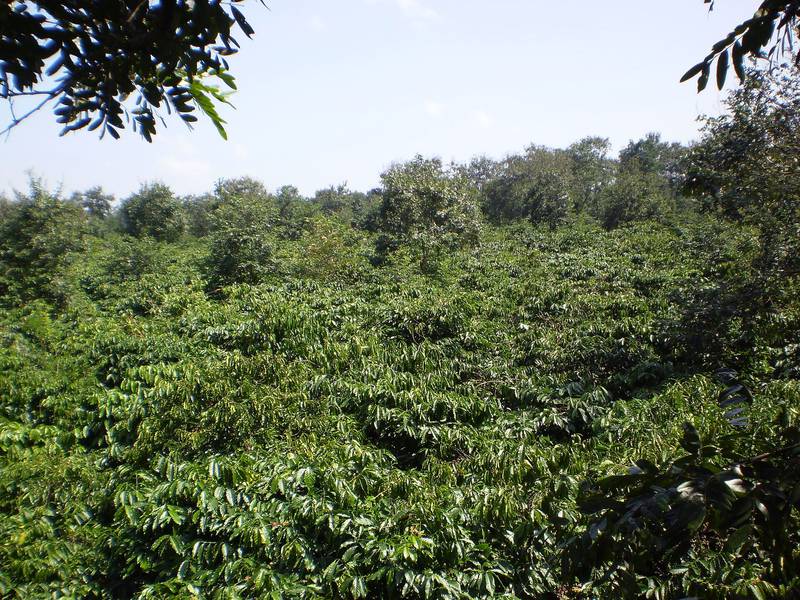
VnExpress adds seasonal highlights: rubber trees change leaves in January, coffee blossoms in March and April, and wild sunflowers bloom in November. Evenings can be chilly, so bring a warm layer, especially for Mang Den. For the rest of the country, see best time to visit Vietnam.
How do you get to and around Kon Tum?
Fly to Pleiku or take the bus from Da Nang. Pleiku airport is about 45 km from Kon Tum, about an hour by car, and in 2024 VnExpress put the bus from the airport at 30,000 VND and a taxi at 500,000 to 650,000 VND. For Friday 6 November 2026, Google Flights showed five nonstop flights from Ho Chi Minh City to Pleiku, each 1 hour 10 minutes, from 994,781 VND on Vietjet, and three from Hanoi, each 1 hour 35 minutes, from 1,210,781 VND.
From Da Nang, Vexere listed buses and vans taking about 7 to 9 hours, from 300,000 VND, for the same date. Our Da Nang to Kon Tum guide compares them, and our Da Nang guide covers the start. From the coffee country to the south, see our Buon Ma Thuot guide.
In town, Grab lists Kon Tum among its service areas, and mia.vn notes that the cathedral and the Bishop's House are close together, with Kon Klor on the same street as the Bishop's House. For Mang Den and the villages, hire a car with a driver. Local Vietnam advises carrying cash, since many places do not take cards.
How much does Kon Tum cost?
Rooms and sightseeing are cheap; transport is the main cost. Prices were checked on 19 October 2026, and we convert at 26,100 VND to US$1, Vietcombank's selling rate that day.
| Item | VND | About US$ | Source |
|---|---|---|---|
| Cheapest double room in Kon Tum, 6 Nov 2026 | 180,000 | 6.90 | Booking.com |
| Central hotel double room, 6 Nov 2026 | About 300,000 to 480,000 | 11.50 to 18.40 | Booking.com |
| Homestay room in Mang Den | 300,000 to 800,000 | 11.50 to 30.70 | VnExpress, 2026 |
| Dorm bed in a Mang Den homestay | 150,000 to 250,000 | 5.75 to 9.60 | VnExpress, 2026 |
| Bus from Pleiku airport | 30,000 | 1.15 | VnExpress, 2024 |
| Taxi from Pleiku airport | 500,000 to 650,000 | 19.20 to 24.90 | VnExpress, 2024 |
| Bus from Da Nang | From 300,000 | From 11.50 | Vexere, 6 Nov 2026 |
| Flight from Ho Chi Minh City to Pleiku | From 994,781 | From 38.10 | Google Flights, 6 Nov 2026 |
Booking.com listed 17 properties in Kon Tum for that night. For budgets across the country, see what a Vietnam trip costs.
What should you eat in Kon Tum?
Try the leaf salad. VnExpress describes goi la, a plate of 30 to 40 kinds of forest leaves in the dry season and 70 or more in the rainy season, eaten with boiled pork, shrimp and a dipping sauce of fermented sticky rice. It also recommends grilled free-range chicken with com lam, sticky rice cooked in bamboo, and bun do, red noodle soup with field crab, meatballs and quail eggs.
Key facts at a glance
- Altitude: about 525 m, in the Dak Bla basin (Wikipedia).
- Province: part of Quang Ngai since 1 July 2025 (Tuoi Tre).
- Cathedral: built in wood from 1913 to 1918 (VnExpress).
- Mang Den: about 1,200 m high and 60 km away (Vietnamese Wikipedia).
- Rain: about 90 percent falls from May to October (Vietnamese Wikipedia).
- Airport: Pleiku, about 45 km away (VnExpress).
Limitations
The Mass times and the Bishop's House hours come from a 2025 travel guide, not from the diocese, and we could not confirm them for 2026. The airport bus and taxi prices, the Indochina junction details and the food notes come from a 2024 guide and may be out of date. The village facts for Vi Ro Ngheo date from 2023, and the rong-house etiquette above is our own advice, since we found no published rulebook. Room prices are one night's listings on Booking.com, and climate figures are long-term averages. Highway 24 and the Ho Chi Minh Road can close for days after heavy rain in October and November, so check the news before you set out to Mang Den or the coast.